 6 months Ago
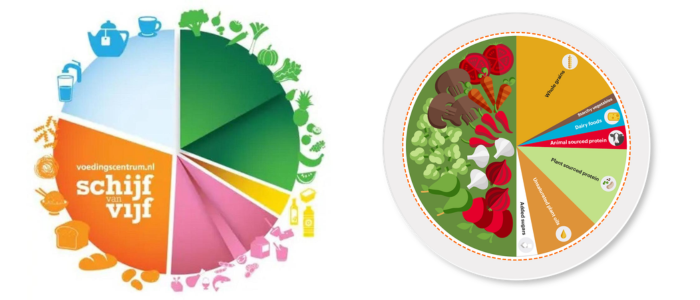
The Schijf van Vijf provides a guide for making healthy and environmentally sustainable dietary choices. The food groups are organized by color: blue (drinks), green (vegetables), yellow (fats and oils), pink (meat and dairy), and orange (grains). While the basic organizational structure of the Schijf van Vijf has not changed, individual food items within each color group have undergone key changes.
In the pink section of the Schijf van Vijf (meat and dairy), there has been a substantial change in the recommendations for meat intake. The previous recommendation for meat intake has been established as 500 g per week → 300 g per week (with a limit of 100 g of red meat per week). The remaining 200 g is recommended to come from fish or chicken. There is also a new reduced recommendation of 20 g of cheese per day.
In direct contrast to the above recommendations, there has been an increase in the recommended intake of lentils and beans to be consumed each week (250g/week). With these changes in red meat and cheese, the Dutch Nutrition Centre encourages a shift away from meat or animal source protein to plant-based protein sources such as beans and lentils as a major source of protein.
The major reasons for the changes to the above recommendations are related to two key factors: Health and the Environment. The updated dietary guidelines are based on current scientific evidence regarding nutrition, health, and eating behaviour. Current research indicates that it is becoming increasingly important for people to eat healthy and sustainable diets, as highlighted in these guidelines. It is reported that approximately 50% of the Dutch population is either overweight or obese, and approximately 1.2 million people in the Netherlands are living with diabetes. Furthermore, the current food system generates approximately one-third of all climate-related impacts.
Water and sugar-free soft drinks are key recommendations for the drink category. Within the grain category, key recommendations for high-fibre foods include whole-grain pasta, whole-grain bread, and brown rice.
Recommendations regarding legume-based products, such as lentils and beans, have recently gained significant attention in nutrition and lifestyle discussions. Experts believe that incorporating legumes and beans into diets can be challenging, as they are no longer staple foods in many diets. It is recommended that the gradual incorporation of legumes and beans into consumers' diets should be encouraged. The Dutch Nutrition Centre has made additional comments regarding accountability, noting that accountability for making healthy food choices does not rest solely on the individual; rather, it also rests with the government (making sound legislative decisions), producers (growing and producing healthy crops), and suppliers (selling the food item(s) to the consumer).