
Introduction
Start tracking your wellness today! 💪Let's be honest. Most of us have a drawer somewhere with a gadget we bought in a burst of motivation and wore for nine days. Mine had a cracked charger and a strap that smelled weird. So when people ask me about the best fitness trackers for everyday use, I don't start with specs. I start with a simpler question: will you actually keep it on your wrist at 7 a.m. on a Monday, and at 11 p.m. on a Friday too?
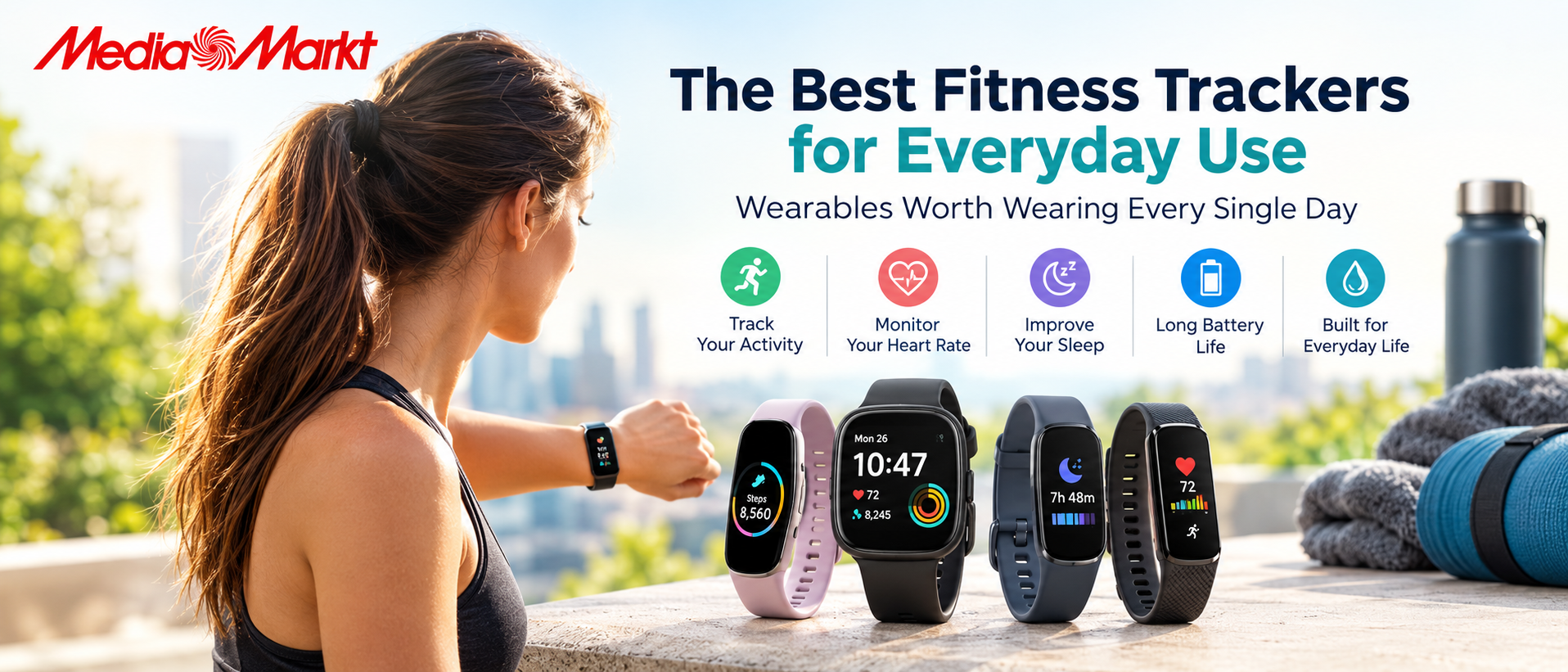
That's the real test. A tracker that sits on your arm, quietly counting, nudging, and logging, beats a powerful one that lives in a drawer. This guide walks through what matters, what doesn't, and where your money is best spent. If you're looking for a fitness tracker that fits your daily routine, MediaMarkt is worth exploring for a range of fitness and wearable tech options to help you find the right device for your needs.
What Makes the Best Fitness Trackers for Everyday Use?
A tracker you can't forget about is a tracker you'll take off. The best fitness trackers for everyday use are light, soft on the skin, and happy in the shower, at the desk, and under a shirt cuff. Slim bands usually win here over bulky smartwatches. A watch case that digs into your wrist while you type is a small annoyance, but small annoyances add up fast.Battery life comes next, and I mean it. If you have to charge something every night, it will eventually miss a night. Then it misses a second night. Then, well, you know. Many slim bands run for a week or longer on one charge, and some budget bands claim two or more weeks. That's the sweet spot, because charging becomes a weekly habit, not a daily chore.
Then there's accuracy you can live with. No wrist device is a medical instrument, and anyone who tells you otherwise is selling something. What you want is consistency. If it counts your morning walk the same way on Tuesday as it did on Thursday, the trends become meaningful, and trends are the whole point.
A decent app matters too. Honestly, a mediocre band with a lovely app often feels better than a great band with a clunky one. You'll open that app every day, so it should be clear, quick, and not shout at you.
Wearable Fitness Devices: What They Actually Track
The phrase "wearable fitness devices" covers a lot of ground: bands, watches, rings, even clip-on pedometers. They all do a few core jobs, though, and it helps to know them.Step Counting
Step counting is the oldest trick in the book, and still the most useful for most people. A tiny motion sensor (an accelerometer, if you want the proper word) detects the rhythm of your arm swing and turns it into a number. Is it perfect? No. Pushing a shopping cart can undercount, and waving your arms while talking can overcount. (I've definitely racked up fake steps during a long phone call.)
Still, as a daily nudge, it works. Many people aim for somewhere around 7,000 to 10,000 steps a day, though research suggests health benefits start well below the old 10,000 target. The exact number matters less than the direction. More movement, most days. That's it.
Heart Rate Monitor
A built-in heart rate monitor uses little green lights on the back of the device to read blood flow at your wrist. It's great for resting heart rate trends, which can drift when you're stressed, sick, or just sleeping badly. During workouts, it's decent for steady cardio like walking, cycling, or an easy jog. Where it struggles? Fast intervals, heavy lifting, and cold weather. Wrist sensors lag a bit when your pulse changes quickly. If you do serious training, a chest strap is still more reliable, and that's fine.
Activity and Workout Modes
Most trackers also log workouts: running, cycling, swimming, yoga, and so on. Some use GPS from your phone, others have built-in GPS. For casual use, phone-connected GPS is plenty. Don't pay extra for built-in GPS unless you really leave your phone at home.
Fitness Trackers With Sleep Tracking: Are They Worth It?
Okay, this one I have mixed feelings about. Fitness trackers with sleep tracking are popular for a good reason, but they can also make you a little neurotic if you let them.Here's what they do well. They estimate when you fell asleep and woke up, how many times you stirred, and roughly how your night split between light, deep, and REM sleep. The stage breakdown is an estimate, not a lab result, so take it with a pinch of salt. Where they shine is the pattern: you go to bed at 11:40 on weeknights but 1:15 on weekends, and your "sleep score" crashes every Sunday. Seeing that on a chart is oddly motivating.
What they don't do well? Tell you exactly why you slept badly. Was it the coffee at 4 p.m.? The neighbor's dog? That spicy dinner? Your tracker won't say. It just shows the damage. Use it as a prompt for questions, not a verdict.
A few practical notes:
- Wear it snug but not tight at night. Too loose and the sensor drifts.
- Pick a slim band if you hate wearing things to bed. Big watches get annoying fast.
- Check the battery routine. If you charge it overnight, you lose sleep data, so top it up while you shower in the morning.
Affordable Fitness Trackers That Don't Feel Cheap
Here's the good news. You don't need to spend a fortune. Affordable fitness trackers have gotten so capable that the gap between budget and premium is smaller than it's ever been, at least for the basics.Budget bands from brands like Xiaomi and Amazfit typically cover step counting, a heart rate monitor, sleep tracking, blood oxygen estimates, and dozens of workout modes, all at a fraction of what big-name smartwatches cost. Many also offer bright AMOLED screens and battery life that stretches past two weeks in light use. Prices change often and vary by country and sale season, so check current listings before you buy.
What do you give up? Usually a few things:
- Built-in GPS (often missing or phone-dependent)
- Contactless payments in some regions
- Polished third-party app support
- Long-term software updates and customer support
A Quick Look at Popular Options
I won't pretend there's one perfect pick, because there isn't. But here's how a few well-known names generally fit different people. Specs and prices change with each new model, so confirm details on the brand's site.- Fitbit Charge series: Often a favorite for beginners. Simple app, slim design, solid sleep and heart tracking, and a weekly-ish battery life. The ecosystem feels friendly, and the health dashboard is easy to read.
- Garmin Vivosmart or Vivofit lines: Garmin leans toward durability and battery life. If you want something that just keeps going without fuss, these are worth a look. The app (Garmin Connect) is detailed, maybe a little too detailed at first.
- Xiaomi Smart Band series: One of the best value picks around. Bright screen, light body, and a long battery. For people shopping on a tight budget, it's often the first name that comes up, and it's widely available in India.
- Amazfit Band series: Another strong budget contender with good battery claims and plenty of workout modes. Worth comparing against Xiaomi, since both are close.
- Apple Watch or Samsung Galaxy Watch: Higher priced, yes, and more of a smartwatch than a simple band. Great if you want calls, payments, and apps on your wrist. The trade-off is a daily or near-daily charge. They also work best with their own phone ecosystems.
- Smart rings (like Oura): Discreet and comfortable for sleep, which is their big selling point. Many require a subscription, so factor that in.
How to Choose Without Overthinking It
I know, I know. Too many choices. Try this instead of reading forty review sites.Ask yourself three things. What do I actually want to track? How much am I willing to spend? And do I hate charging things?
If you mostly want step counting and casual health insight, go with a budget band. If sleep is your main thing, look for comfort and a good sleep app. If you train seriously, spend more on GPS and heart rate accuracy. And if you want your phone's notifications on your wrist, a smartwatch makes sense.
Also, check compatibility. Some bands play nicer with Android, others with iPhone. It's a boring detail, but it can save you a return.
One more thing, and maybe this is silly: try it on. If you can, wear it in a shop for a few minutes. Does the strap itch? Is the screen readable outdoors in bright Indian afternoon sun? (Reflective screens can be a pain at noon.) Little things like that decide whether a tracker becomes a habit.
Common Mistakes People Make
A few traps worth dodging.Chasing numbers instead of habits. Hitting 10,000 steps by pacing the living room at 11:55 p.m. counts, technically. But is that the point? Use the data to build routines, like a short walk after lunch.
- Trusting calorie estimates too much: Calorie burn figures are rough guesses. Don't eat your entire dinner "back" based on a wrist number.
- Ignoring updates and fit: A loose strap wrecks heart rate accuracy. A dusty sensor does too. Wipe them back now and then.
- Buying too much, too soon: Fancy features you never open are just expensive decorations.
- Giving up after a slow week: Habits wobble. Your tracker will show a bad Tuesday and a great Saturday. Both are fine.
Final Thoughts
So, what are the best fitness trackers for everyday use? The ones you'll actually wear. That's the unglamorous truth. A comfortable band with reliable step counting, a steady heart rate monitor, and decent sleep tracking will do more for you than a feature-packed gadget you resent charging.Start with your real needs. Be honest about your budget. Remember that affordable fitness trackers today are genuinely good, and that wearable fitness devices are tools, not judges. If you're ready to find the right device, MediaMarkt offers a range of fitness trackers and smartwatches to explore, making it easier to compare features and find an option that fits your lifestyle and budget. Use the data to notice patterns, adjust little things, and feel a bit better week by week. Pick one, wear it for a month, and see what it tells you. You might be surprised by how much you learn about your own days.
Start tracking your wellness today! 💪
FAQs
1. Are affordable fitness trackers accurate enough for daily use?
For most people, yes. Budget trackers handle step counting and resting heart rate reasonably well, and consistency matters more than perfect precision. They're less reliable for intense interval training or exact calorie burn. If you only need general activity and wellness trends, an affordable band is usually plenty.
2. Do fitness trackers with sleep tracking really measure sleep stages correctly?
Not exactly. They estimate light, deep, and REM sleep using movement and heart rate, so the stage breakdown can be off compared with a sleep lab. Total sleep time and bedtime patterns are generally more trustworthy. Treat the data as a guide to your habits, not a medical diagnosis, and talk to a doctor if you have ongoing sleep problems.
3. How long should a fitness tracker battery last for everyday use?
It depends on the type. Slim bands often last from about one week to over two weeks per charge, while full smartwatches typically need charging every day or two. For everyday wear, a longer battery makes it easier to keep the habit, especially if you want sleep data without gaps.