 3 months Ago
A Late Twist That Changed Everything
England took the lead through Anthony Gordon in the 55th minute and looked on course to reach the final. But Argentina refused to fold. Enzo Fernández and Lautaro Martínez struck late goals, both created by Messi, to complete the turnaround. What made it even more remarkable was that Argentina became the first team ever to score multiple second-half stoppage-time winners in a single World Cup.
Lautaro's goal carried extra weight too. He became the first Argentine player to score more than one World Cup goal off the bench in the same tournament. His effort marked the fourth stoppage-time winning goal scored by a substitute in this year's knockout stage alone, more than every previous World Cup combined, a stat that only applies since substitutions were introduced back in 1970.
Interestingly, this was Argentina's first win over England since the 1986 World Cup quarterfinals, snapping a five-match winless run against them across all competitions. England, meanwhile, continued a rough historical trend, having now been knocked out in three of their four World Cup semifinal appearances, with 1966 being the only exception, a tournament they hosted and won. Their five shots on the night were also the fewest recorded by any team in a World Cup match over the last six decades, and their possession dropped to just 12 percent in the closing stretch of the game, one of the lowest such figures seen in this tournament.
Messi Keeps Rewriting the Record Books
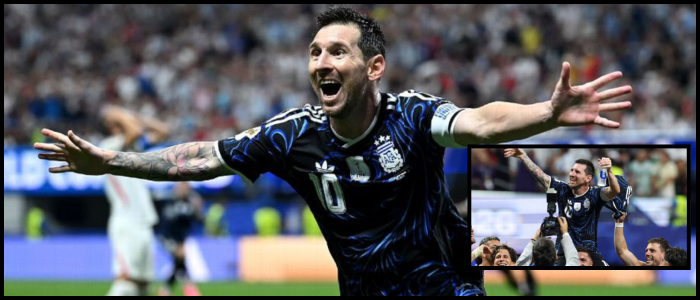
At 39 years and 21 days old, Messi became the oldest outfield player to ever feature in a World Cup semifinal, trailing only two goalkeepers in history for that distinction. Age clearly hasn't slowed him down. He covered 8.35 kilometers during the match, his highest distance covered in a game that didn't go to extra time this tournament, and he won 12 duels, his best tally in a World Cup match since 2014.
His creative influence was just as striking. Messi set up two goals in the semifinal, becoming just the fourth player in 60 years to register multiple assists in a World Cup semifinal. That performance also meant he has now scored or assisted in 11 consecutive World Cup matches dating back to 2022, extending a streak no one else has matched in six decades. He also created an expected assists value of 0.86 in the game alone, higher than England's entire team combined.
Zooming out to his full World Cup career, the numbers become even more staggering. Messi now has 33 goal contributions in 33 career World Cup appearances, comfortably ahead of Kylian Mbappé, who sits second with 25. He also leads all players over the last 60 years in chances created, with 99 so far, and one more will take him to the 100 mark. Diego Maradona is next on that list, but with only 71.
In this tournament alone, Messi has created 25 chances, just short of the all-time single-tournament record of 31, held jointly by Johan Cruyff and António Simões. Among Argentine players, only Maradona's 30 chances created in 1986 rank higher. Messi is also tied with Mbappé for the tournament's top scorer with eight goals and sits one assist behind leader Michael Olise. Notably, the last player to lead or share the lead in both goals and assists in a single World Cup was Thomas Müller back in 2010.
Argentina's Chase History Against Spain
With this win, Argentina reached their seventh World Cup final, matching Brazil for the second-most final appearances in history, behind only Germany's eight. It's also the first time since 1986-90 that Argentina have reached back-to-back finals. Should they beat Spain, they would join Italy and Brazil as the only nations to win consecutive World Cup titles.
The final itself carries historical weight beyond the two teams' recent form. It will be the first World Cup final ever between the reigning European and South American champions, and since FIFA rankings began in 1992, it will also be the first final to feature the top two ranked teams in the world, with Argentina at No. 1 and Spain at No. 2. Historically, Argentina hold a 6-2-6 record against Spain across all competitions, including a 2-1 win in their only previous competitive meeting, back in the 1966 World Cup group stage.
For Messi personally, reaching Sunday's final would mean appearing in his third World Cup final, a feat only Cafu has previously achieved. He has now reached the final in eight of the thirteen major tournaments he has played for Argentina, a conversion rate of over 61 percent, further cementing his case as one of the greatest big-game players the sport has ever seen.
Elsewhere, England's Harry Kane made history of his own, becoming the nation's most-capped outfield player with his 121st appearance, moving past Wayne Rooney. Only former goalkeeper Peter Shilton has represented England more times.